
| Deepak Chopra |
As the ancient Indian rishis declared, “Those who know it speak of it not. Those who speak of it know it not.”
It’s only sensible to ask if such knowing, being impossible to talk about, is actually real. This has been a vexing dilemma that gave rise to two huge topics in philosophy: ontology (the study of being) and epistemology (the study of how we know things). Both topics are gnarly and entangled, and Indian philosophy isn’t immune from that. But we can cut the Gordian knot with another expression from the ancient seers: This isn’t knowledge you acquire. It is knowledge you become. God, like the universe and reality itself, is participatory. There is no other choice, since existence is always on the move, which is why I’m fond of saying that God is a verb, not a noun.
If the argument feels like it’s getting opaque, I can offer an analogy that helped me when I first heard it. Imagine that your mind is like a river. On the surface a river is filled with activity in eddies and waves. As you go deeper, the waves subside into a steady current. Deeper still the current slows down, and at the very bottom of the river, there is no current at all as water settles into the underlying river bed. Just as we can trace a river from its most agitated state to a level of complete stillness, the mind can follow itself from the stream of consciousness to deeper levels until it encounters its source in silent awareness. The entire journey is accomplished within awareness; the beginning, middle, and end are all conscious.
The practical result of this dive into awareness is not abstract knowledge. Reality is different in different states of consciousness—another maxim from the ancient rishis. Therefore, God isn’t merely process but transformation. In this book the authors were assigned the topic of “the immanent God,” which acquires its importance as a kind of rescue mission. As the transcendent God loses significance in the modern world, we must turn to immanence—“God in us” or “God in everything”—to justify the divine. I have to agree, but with the proviso that transcendence and immanence aren’t relevant distinctions in the end. We don’t say, “Existence is way up there, beyond the clouds. Have faith and you will find that existence is down here, too.” Likewise, if God is existence, being “up there” or “down here” has no meaning.
…
I am the union of two parents, in a sense, unwilling to rely on science or faith alone but equally unwilling to let go of either strand. It’s a peculiarity in human beings that we never settle on a fixed identity, the way a tiger has tigerness and per- haps an angel has angelness. In the evolutionary scheme, our specific mutation is to embody mutability. I feel that personal- ly every day, and if you ask me “Who are you?” I don’t resort to memory, family, labels, and other remnants of selves that have drifted in and out of the picture since I was born. All statements of “I am X” fall short—even “I am God”—to explain what is real at this very moment. Existence is on the move, and the only reliable guide into the unknown is reality itself.
Excerpted from:
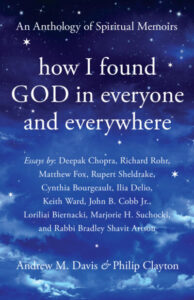
How I Found God in Everyone and Everywhere, Volume I
By Andrew M. Davis & Philip Clayton
Save 20% on Monkfish titles on Indiepubs, with FREE SHIPPING for orders of $40 or more.
You can subscribe to The Monkfish Reader here.
|
Raymond Moody, professor of philosophy as well as an MD, coined the phrase “near-death experience.” He shares the following observations from his many interviews with people who had them. |
| [L]ove is a wonderful, multifaceted, complex thing. I have been going on and on about love because of what people with near-death experiences tell us. They said that during their life reviews they discovered that the purpose of this life is to learn to love. But what kind of love do they mean?
To me, life reviews are perhaps the most interesting elements of people’s near-death experiences. After they left their bodies, time came to a standstill and a panorama appeared around them of everything they had done in their life. They experienced every action in review but not just from the perspective they had at the time the action took place. Instead, they also revisited the action from the perspectives of the people with whom they had interacted. Hence, when they reviewed scenes in which they had treated someone else harshly, they directly felt the pain their action had caused. Or in scenes in which they had treated others with loving kindness, they directly and emphatically experienced the good feelings their actions had created. In these reviews, God was aware of every action and prompted the person with a question, though the question was not in words. Rather, God directed a thought to the person. People invariably put the question into words as something like, “How have you learned to love?” Whatever appeared in the panoramic review, people felt that God loved them for themselves, completely and totally. The situation itself naturally made people want to be that same way. People generally told me that God did not judge them during their experience of the review. God’s purpose seemed to be education, not judgment. Life reviews during near-death experiences are suffused with God’s light and love. People with transcendent near-death experiences return with a conviction that learning to love is the essential meaning and pur- pose of life. Yet they often find it difficult to adhere to that standard while living in this world. Even my friend George Ritchie, the finest person I ever knew, complained of his problem, “Raymond, this experience makes your humanity even more of a burden, in a way.” What George meant was that even after seeing the vital importance of love, we are still human beings and often lack love. And that does not change just because of a life review during a near-death experience. What does change, however, is someone’s underlying motivation. After life reviews during their near-death experiences, people are more strongly motivated to change. They generally become more loving in their daily lives. During my career, I got to know thousands of people with stories of their near-death experiences. I think that they do very well in their quests. Many of them recounted to me that after their experiences they occasionally felt a longing or intense nostalgia or homesickness for the love of God. I suspect that God’s love for us is multidimensional in ways we are incapable of comprehending or even imagining while living this life. God’s love has all sorts of manifestations and powers that are beyond the reach of the mind. However, one thing does seem clear and demonstrable. Specifically, God’s love for us is somehow tied to our capacities to create, tell, and appreciate stories, or narratives. Excerpted from:
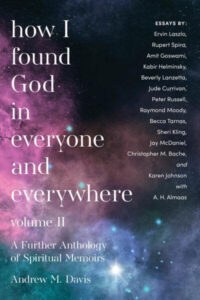
How I Found God in Everyone and Everywhere Volume II. A Further Anthology of Spiritual Memoirs By Andrew M. Davis Save 20% on Monkfish titles on Indiepubs, with FREE SHIPPING for orders of $40 or more. You can subscribe to The Monkfish Reader here. Follow us on social media:
|