

Jon M. Sweeney writes about Saint Francis of Assisi
|
Example #13: Sitting on the Ground |
|
Francis was all about not knowing many centuries before it became a thing to talk about. For him, not knowing took a deliberate and practical form that resembles what we saw in Roshi Bernie Glassman and the Zen Peacemakers movement he founded in 1994. They were committed to paying little attention to intellectual matters for the sake of living with a naïve openness in their communities. They summarized this in three clear principles: Not Knowing: letting go of fixed ideas about yourself, others, and the universe. Bearing Witness: to the joy and suffering of the world. Taking Action: that arises from Not-Knowing and Bearing Witness. Sitting on the ground was when Francis was by himself, in the midst of a life devoted to not knowing, bearing witness, and taking action. He was on the ground to identify with what’s there, and to refuel. Like raising his arms to the sky, sitting on the ground was an embodied expression of his faith. To sit on the ground, like a creature. To be low to the ground as one who is lowly, humble, and poor—like, for instance, the migrant Mary and the infant unwanted Christ in the manger, in Bethlehem. It was also a bit crazy. Who did such things?! Throughout history, what others perceive as madness has always been the catalyst for new ideas, breaking superstitions, and hearing anew the voice of divinity. One day at Greccio, Francis was staying with his brothers there when they were also expecting one of their religious leaders to arrive for dinner. The table was festively set and a menu prepared. The narrator tells us: “It happened that the brothers of that place on Christmas day itself prepared the table elaborately because of a visiting minister, covering it with lovely white tablecloths which they obtained for the occasion, and vessels of glass for drinking.” One imagines Francis refusing to sit at the table, taking a place on the floor instead. In fact, when he arrives to eat the meal, and sees the table set so finely, Francis quietly leaves and dons the “the hat of a poor man,” it says, and carries a staff down to the road, where he begins to beg for his bread as a friar is supposed to do. A little while later he knocks on the door, like a pilgrim might do, and shows the friars who answer it what he has to eat. He was, of course, making a point. Taking on flesh, in such poor circumstances, the holy Child from his first hour had nothing, was identified with the poorest of the poor. There are other, more literal examples of Francis sitting on the ground—as when he stepped down from leadership in his religious order. At the next general-chapter meeting, with thousands of friars in attendance, there we see Francis the founder sitting at the feet of the new minister-general occasionally asking for permission to speak. His humility was not put on for show, but arose from his understanding that all creation prays. We see this in the “Canticle of the Creatures,” the first vernacular Italian poem ever written—the one that praises Sister Moon and Stars and Brother Wind. And Francis’ poetry was prophetic in the way suggested by Czeslaw Milosz: “The poetic act both anticipates the future and speeds its coming.” |
From:
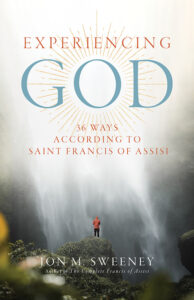
Experiencing God: 36 Ways According to Saint Francis of Assisi
By Jon M. Sweeney, Monkfish 2026.
Save 20% on Monkfish titles on Indiepubs, with FREE SHIPPING for orders of $40 or more.
You can subscribe to The Monkfish Reader here.
Follow us on social media: