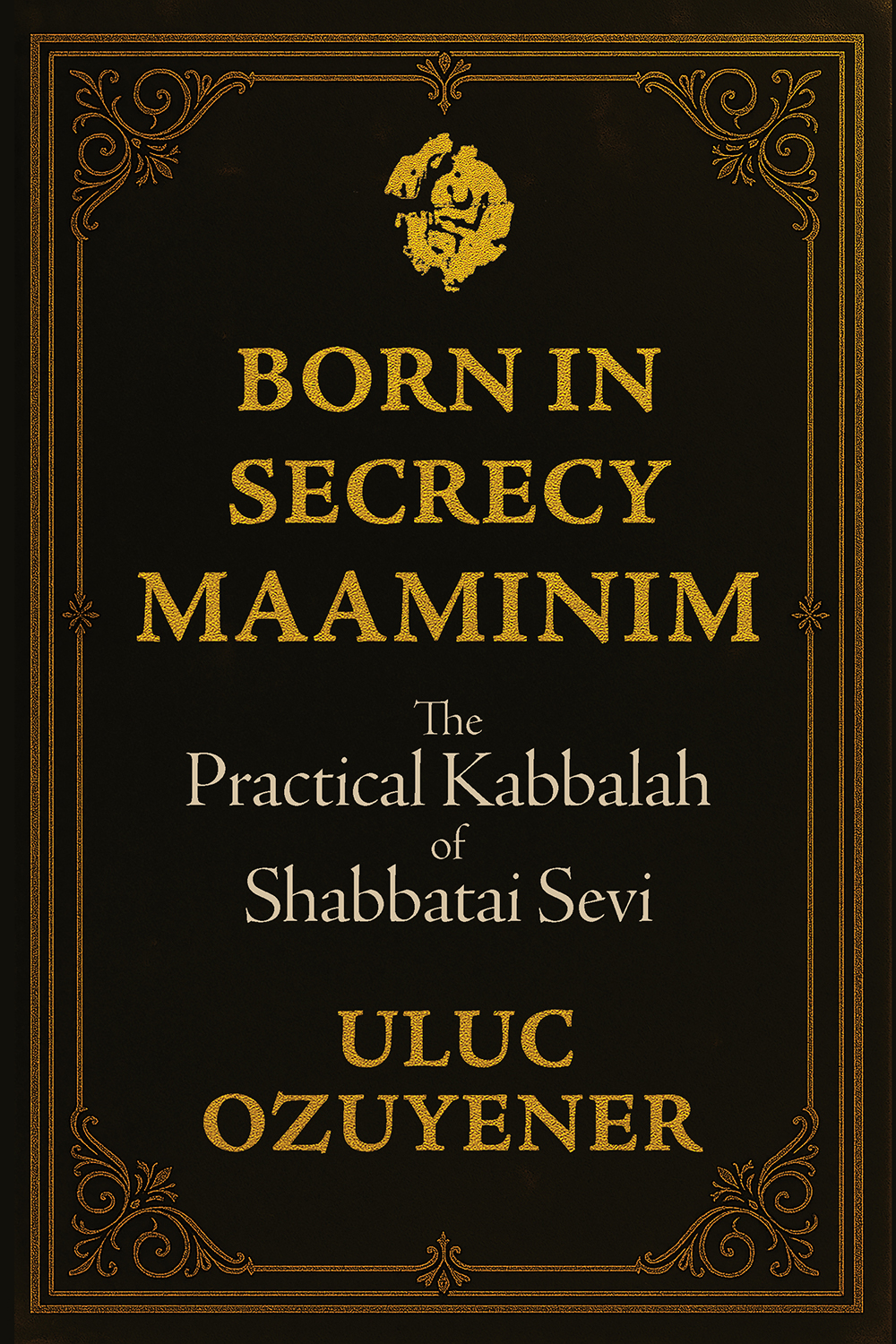
Born in Secrecy—Maaminim
The Practical Kabbalah of Shabbatai Sevi
Uluc Ozuyener
Paperback
ISBN 9781966608516
$35.00 US
eBook available
October 6, 2026
This book tells the story of the Sabbatean descendants who continued to carry the spark of faith in the enigmatic Shabbatai Sevi (1626-76), not in public, but behind closed doors, through gestures, rituals, and coded language. This is the story of those who have long lived in shadows. It is the first book on Sabbateanism written from within the tradition.
As a descendant of the Maaminim (a devoted circle of Shabbatai Sevi’s first followers), Uluc Ozuyener gives voice to a history that has lived in silence. His book is both a personal journey and scholarly exploration—to reveal how a faith could survive, and even flourish, through exile, contradiction, and concealment. It weaves together theological analysis, archival research, Ladino hymns, Zoharic commentary, and personal testimony. Ozuyener engages with the Kabbalistic foundations of the worldview—particularly the belief that exile and descent are not signs of failure, but sacred processes through which hidden light can be revealed. The Maaminim believed holiness could emerge from darkness, that fidelity could be expressed through transgression, and that secrecy was not simply survival—it was devotion.
 Uluc Ozuyener founded the Society for Sabbatean Studies, the first international organization dedicated to preserving and illuminating the heritage of the Maaminim, the hidden followers of Shabbatai Sevi. He is a descendant of the Sabbatean Kapancı sect, born in Turkey, now living in the U.S. Professionally, Ozuyener leads global IT teams, but beneath the surface of his technical career has been a devotion to this subject. His public contributions include interviews and articles in Şalom, the leading Jewish newspaper in Turkey, and a widely viewed conversation with journalist Ruşen Çakır on Medyascope (you can turn on the English translation while watching), where he discussed the lived experience of Sabbatean descendants. His fluency in Turkish, English, and Spanish, and his deep grounding in Ladino culture, enable him to work with rare manuscripts, oral traditions, and mystical hymns with both intellectual rigor and emotional intimacy.
“This book offers a rare and intimate window into the world of the crypto-Sabbateans: inevitably idiosyncratic, yet deeply representative of the lived religious imagination of generations who held fast to a paradoxical faith in silence. It is at once personal testimony and collective memory—three and a half centuries of Ladino hymns, ancestral whispers, and inherited gestures, refracted through a mind fully conversant with modern Sabbatean scholarship and unafraid of its tensions. Written with lyricism and restraint, a distinctly mystical melody runs through every page. It is unlike any other book I know on a subject close to my heart: one that has much to say, but says the most through how it speaks—patiently, obliquely, and with profound fidelity to a tradition long practiced beneath the surface of history.” —J.H. Chajes, Wolfson Professor of Jewish Thought, University of Haifa
“Sabbateanism, which took shape in the seventeenth-century Ottoman world, marks a pivotal yet often misunderstood historical moment in Jewish history. Although nourished by Kabbalistic foundations, the movement developed its own distinct theology and ritual life. At its center stands a striking reinterpretation of the Messiah: a redeemer who must descend in order to ascend, entering darkness so that cosmic tikkun may unfold. This is a messianic drama announced through suffering rather than joy—a paradox that defines the core of Sabbatean thought. Written by a scholar formed within this very lineage, the book weaves rigorous historical methods with the subtle inheritance of a living tradition. It offers not merely an intellectual analysis but a study shaped by an inner familiarity with its sources, resulting in a work both authoritative and quietly poetic. It stands among the most significant contributions to the field in recent years.” —Kursad Demirci, Professor of History of Religions, Marmara University
“Credos are meant to express the most widespread consensus of a belief. As such, they are deliberately formulated in the first person singular. Compare Greek Πιστεύω to Latin Credo, Hebrew אני מאמין (ani ma’amin) to Arabic آمنتُ (āmentu). All of them say ‘I believe,’ not ‘we believe.’ Totally unexpectedly, the title of the long-awaited book Born in Secrecy—Maaminim adopts the first person plural. No doubt, this serious and dedicated work also reflects shared beliefs and perspectives of the Sabbateans in general and of the Kapancı community in particular. But before and after anything else, it is a personal mosaic: fragments inherited from family, conclusions drawn from careful observation of narratives and practices within the community, and academic knowledge gathered from dozens of books and scholarly studies. It is a mosaic created by a single contemporary Sabbatean intellectual, during a lifelong search for the meaning of the unique and beautiful heritage he was born into. The historical, social, and ethno-psychological importance of Ozuyener’s book for the Sabbatean community can be compared only to its immense contribution to the scholarly world.” —Eliezer Papo, senior lecturer, Ben-Gurion University of the Negev; President, Israeli National Authority for Ladino Culture
“A modern Sabbatean reflects on the origins and enduring legacy of the Jewish sect’s teachings. Born a Romaniote Jew in the Ottoman Empire in the 17th century, Shabbatai Zevi is known not only for his idiosyncratic teachings and claims to be the Jewish Messiah, but also for his subsequent conversion to Islam by imperial authorities upon the threat of death. Though this history is well documented, the controversial Jewish figure’s legacy and teachings within the Sabbatean movement remain shrouded in esoteric mystery. In this erudite (yet personal) consideration of the Sabbateanism teachings, Ozuyener—a descendant of Shabbatai’s loyal ‘right hand’ devotee, Rahamim Levi—blends scholarly research with an intimate familiarity with the mystical teachings passed down to him through the generations. In addition to his analysis of Shabbatai’s teachings (the author emphasizes that they are less a body of knowledge to be studied than ‘a way of being’ and ‘sensitivity to the hidden structure of the world’), Ozuyener pays particular attention to his legacy, arguing that his conversion to Islam was born out of political necessity as an act of ‘spiritual concealment.’ As a belief system forced underground by persecution, the ‘subterranean influence of Sabbateanism,’ per the author, can be seen in a myriad of subsequent Jewish sects, from Hasidism to Frankism. Moreover, in our modern age of consumerism and technology, Sabbateanism, according to Ozuyener, ‘stands in stark contrast to the sterile, reductionist worldview that often dominates contemporary thought,’ since it frames spiritual growth not as a result of rigid dogma, but of genuine spiritual connection. As the founder and president of the Society for Sabbatean Studies, Ozuyener has a firm grasp on Shabbatai’s life and teachings in addition to fluency in multiple languages, all of which allows him to explore a diverse set of primary sources from Judeo-Spanish, Turkish, and English archives. The book’s scholarly underpinnings, bolstered by more than 350 endnotes, are balanced by an engaging writing style that leans heavily on Sabbateanism’s rich literary legacy, offering readers poignant excerpts from the movement’s hymns, prayers, and poetry. A welcome addition to the literature on a controversial, often misunderstood, Jewish mystic.” —Kirkus Reviews