

Lex Hixon on Sri Ramakrishna
Talk from February 6, 1972
I was turned on to The Gospel of Sri Ramakrishna for the second time by a member of the Natural Church and Curandero Center. The members lived on the top floor of the loft building on Bond Street near Bowery, where we lived in the mid-1960s. Their main sacrament was marijuana, which they smoked every day. It made them more “objective,” they told me. They used to come downstairs to have coffee with us and talk. One of them saw The Gospel of Sri Ramakrishna among my books one day, and said, “Far out, man, that’s a far-out book. We’re working with the I-Ching now. Next, we’re going to work with that one.”
After they left, I took the book down and began reading it. I was feeling generally depressed at the time, and I noticed right away that the depression lifted. This experience may have been the key to my desire to enter spiritual life, because I couldn’t stand to be subject to these depressions that would come over me. I really don’t think it was for any abstract philosophical reason or deep inner calling that I chose the life of a seeker.
I hadn’t looked at the book for several years since I had ordered it when I was a senior in college. It was on the recommended reading list for a course that I took in comparative religion, and it was described as a stenographic record of the conversations of a very high saint of late 19th-century India. I was interested in the description and I read a little of it, but all I can remember now was the incense inserted throughout the book and the fragrance. Later, I found out that at the Ramakrishna Center on 94th Street, they stored the books next to the incense, which totally permeates them. I can remember lying in the grass with my face in the book, breathing it in. The fragrance stayed with me, although I put the book down. After I first got the book, I had some hard things to go through. My first wife and I were getting a divorce, and, due to my own mistakes, I had lost my first job out of college as a teacher. It shows that if you’re not ready, you just cannot get into these deep matters.
I had to wait for the right time to reencounter the book that would have such a profound effect on my life. It was about three years later, after I had remarried and my wife, Sheila, and I were living in a loft in the East Village,when my stoned upstairs neighbor brought the book back into my awareness.
At the time, I was lifting weights at the Sheridan Square gym and beginning to feel the aesthetic gap between my own feelings and sitting around with my friends at the gym looking at our “cuts” in the mirror, admiring the definition of our muscles. I realized there might be something more in keeping with my hippie-poet lifestyle to get me into physical shape, like yoga.
I decided to go to the address on East 94th Street that was on the back of the book I had started to read again. At that time, we only ventured above 14th Street once a week to the Art Students League on 59th Street, where Sheila was studying. She would paint and draw, and I would sit outside, reading Wittgenstein on a sunny bench. I was working on a Master’s degree in philosophy at The New School.
One day I decided to stroll over to Fifth Avenue and take the bus up to 94th Street. The first thing I saw was the elegant Audubon House on the corner of 94th and Fifth Avenue, which gave me a feeling I was in a very different realm than I had imagined. I wandered down the beautiful street, and a few doors in, I saw an imposing gray stone townhouse covered with a huge wisteria vine, which is the Ramakrishna-Vivekananda Center.
I rang the doorbell and a little man who looked like a squirrel fattened for winter came out and told me that there was no yoga, but that the Swami spoke every Tuesday and Friday at 8:00 in the evening and every Sunday at 11:00 in the morning. Sheila and I went to the next talk and I forgot entirely about yoga breathing exercises, the Sheridan Square gym, my philosophy degree, and everything.
After a few months of beginning meditation, I received a spiritual initiation from the Swami. He didn’t ask me to cut my hair or beard, but he did ask that I wear a coat and tie to his talks instead of my customary t-shirt. Gradually, he helped me mature, but in such an understated way. He asked us to stop taking part in anti-Vietnam War marches. He thought it was dangerous for us as Sheila was pregnant with our first baby. He also counseled us not to have any alcohol or drugs in our home. We followed his advice and our life became simplified.
It was so difficult to see anything extraordinarily spiritual in him, and yet I felt an inner attraction, the sense of a tremendously balanced, spontaneous, free human being who just happened to wear three-piece suits, had a velvet cape for the opera in his closet, and invited us often to four-o’clock tea that was served out of a proper teapot every afternoon in his study on the third floor of the townhouse.
Before meeting Swami, I had done a few psychedelic trips in the early ’60s, but I felt that one should be able to achieve these experiences without drugs. I soon found that the point of meditation wasn’t simply to get high by a different method. I never have had many visions or ecstatic experiences in meditation, although I did have one intense experience early on that served to establish my deep connection with Ramakrishna. I was meditating in our loft on the Bowery that had a big storefront window. The sun was floating in. We had been taught to meditate by concentrating on keeping a still flame in our heart. I was deep in concentration when suddenly the perspective changed. I saw that the flame was actually an open portal. I looked through this open portal, and inside I saw Ramakrishna sitting in meditation. His body was golden, the color of the flame. Everything around him was golden too.
I stepped in through this door and when I looked down, I saw my body was also golden. Everything was this golden flame color. I went to Ramakrishna and sat down near him. As I looked around, all I could see was a little black flame in the brightness, which was the way back into the realm of ignorance. I stayed there as long as I could. It began to fade out, but the bliss that I experienced stayed with me for hours and hours. I wandered around the mid-’60s East Village in a state of inebriation. I tried to order a sandwich at the deli, but I couldn’t even speak so I had to leave.
Nothing like this has ever recurred, but at the time I didn’t realize how special it was. It was not imagination in any ordinary sense. Since then, I’ve realized that insight, preparation, and balance are all important in spiritual life. Meditation on Ramakrishna and studying his life has been profoundly purifying, gradually changing our lives.
I went back to graduate school at Swami’s request, though I had left the New School, thinking that I was rejecting academic life. Swami regarded study as a suitable austerity for the contemporary environment—more meaningful, in my case, than walking barefoot through India. One day I shaved my beard, just because I didn’t want to create any feeling of separation from other people. We moved out of the Bowery. Sheila and I found a quiet place up on the Hudson. We had three babies and I watched them being born. We made a special meditation room in our house. Life became more and more mellow. We spent almost every summer at a retreat with Swami on the St. Lawrence River. Worldly friends wandered away and spiritual friends appeared. Academic life became enriching for me. The insight was deepening. A natural ease was arising. There was a simplifying of speech and thought.
The Sanskrit word for a holy man, “sadhu,” ethnologically means “straight,” as in straight to the goal. There was an alienation from the hip world, which some of my friends have yet to appreciate. Suddenly, from being a pejorative term, the term “straight” had a new significance.
There is a sense of invisible guidance centered in the figure of Ramakrishna. I am continuing my study and practice of his teachings. He is a truly unique and gifted spiritual being.
Ramakrishna was born in 1836 to orthodox Brahmin parents in a little village far from Calcutta, absolutely untouched by Western civilization. There were signs before his birth and during his childhood that he was a special spiritual manifestation. As a young man with no education, he went to become a temple priest in the Dakshineswar temple garden in Calcutta, worshipping Goddess Kali ritualistically every day.
He fervently longed for a vision of the goddess. It came to him just as he desperately grabbed the sword that hung by her shrine, in order to end his life. He saw an infinite sea of light, which was immensely dynamic, full of waves. The mother’s form emerged with four arms, granting boons, fearlessness, smiling, speaking, consoling, instructing. And then he fell into unconsciousness. After this, he had almost unbroken communion with this divine form, and was often heard by his disciples having long conversations with Mother Kali.
Then he began his many other sadhanas. All of them rose spontaneously in him. For one, he took the role of Hanuman, the Monkey King, who was the servant of Rama. This is the path that Baba Ram Dass has chosen. The name Ram Dass means “a slave of Rama.” And Ram Dass worships the image of Hanuman. But Ramakrishna immersed himself so intensely in Hanuman that he lived naked in the trees, only eating nuts and fruits, and tying a cloth around his waist to make a tail. When he came down from the tree, he would hop instead of walking. This was the intensity of his sadhanas. People understandably took this for insanity.
Finally, Ramakrishna was blessed with a vision of Sita, who is Rama’s divine female consort. She bequeathed him her smile. After that, even in deepest states of Samadhi, he always had a bewitching smile across his face.
He used to do Tantric practices that no one directed him to do, but which he simply came upon by himself. He held a rupee in one hand and earth in the other, or feces in one hand and fragrant sandalwood paste in the other. He would practice contemplating the absolute equivalence of these things. At this time, he cleaned the latrines of the poor people with his long hair, practicing radical humility. All this, the advanced spiritual seekers [around him] recognized as divine intoxication.
He consented to be married because his relatives thought it would bring his mind down [to earth]. And a young girl, Sarada Devi, was found in a neighboring village. She somehow understood his spiritual state and they lived separately as celibate partners in the temple garden until his death. Sarada Devi later became a rich dimension of Ramakrishna’s manifestation, and after his death in 1886, she carried on his transmission of spirituality into the 1920s.
At this time, Mathur Babu, the head of the Kali Temple, had an interesting vision of Ramakrishna. Mathur Babu was sitting in his office. He was a worldly man, but with an intense, passionate heart. One day he noticed that Ramakrishna was strolling back and forth on the terrace in front of his room at the temple. When Ramakrishna turned to him, he became pale white, covered with ashes, matted hair, holding a trident. He appeared exactly in the form of Shiva. When he turned to walk the other way, his skin became black and he had four arms. He was Mother Kali. Mathur was in an ordinary frame of mind. He rubbed his eyes. He stared and stared, but it persisted. From that time on, he regarded Ramakrishna as a high manifestation, and he protected him.
Finally, after many intense sadhanas, the Vedanta sadhana of the Master unfolded. Vedanta is the path of total non-duality without even a vestige of ritualistic duality. Totapuri was the name of the teacher. All these teachers just happened to come to the temple garden in a very natural way.
That night there was an initiation and Totapuri instructed Ramakrishna to go beyond form. So Ramakrishna concentrated, and immediately the Divine Mother’s blissful form appeared between his eyes. He reported this to Totapuri, who said, “You must go beyond form. Try harder.” And again, Ramakrishna concentrated, and again, the blissful Mother appeared because his mind was so centered on that divine form.
Totapuri got angry and took up a sharp stone and pressed hard between the Master’s eyebrows, saying, “Now concentrate on that pain.” And the Master tells us that the pain became a sword of wisdom. When this last and highest form of the Divine Mother came forward, he obliterated it and his consciousness flowed into the formless. He went into deep Samadhi, and for two days, there was no consciousness or any breath. He was sitting as if he was dead, yet he was certainly not dead. There was a vibrancy and a luminosity about him. Totapuri marveled, “What took me 40 years of intense practice to achieve, this man has achieved in a single night.”
This was, in a way, the culmination of Ramakrishna’s sadhana, but he had two other sadhanas to accomplish after this. One was the Islamic sadhana. A Sufi master came by the temple garden and Ramakrishna submitted to him as his guru. Ramakrishna took all pictures of Hindu gods and goddesses out of his room and stopped visiting his beloved Kali temple. He repeated instead, incessantly, the name, “Allah, Allah,” day and night, feeling immense bliss and had a vision of Muhammad entering his body. Sometime later, the Master practiced Christianity once more, ignoring the Hindu gods and goddesses and temples, listening instead to the Bengali translation of the New Testament and gazing at a picture of Mary and the child Jesus. He finally had an intense vision of Christ entering his body.
And now the Master’s great inclusive sadhana was complete. He began to give forth the wisdom and immense spiritual powers he had attained. He maintained his respect for all spiritual figures, including Muhammad, Christ, and the countless Hindu forms of the divine, based on his own experience.
He was a fully-opened, spiritual master, with no sense of the exclusivity of one system of practice; very unique in spiritual history. Powerful young disciples began to come to him, whom he shaped into spiritual geniuses in their own right. Swami Vivekananda is the best known to us. He carried the teachings of his perfected guru to the West for our benefit. May we bow before this wonderful spiritual being, Sri Ramakrishna Paramahamsa!
From:
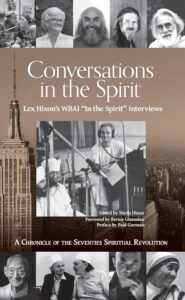
By Lex Hixon, Monkfish 2016.
Save 20% on Monkfish titles on Indiepubs, with FREE SHIPPING for orders of $40 or more.
You can subscribe to The Monkfish Reader here.
Follow us on social media: