

Or N. Rose writes about Rabbi Abraham Joshua Heschel
|
From chapter 15, “In the Footsteps of the Prophets” |
|
It was in the early 1960s, while finishing an expanded English version of his doctoral thesis on the prophets of the Hebrew Bible—the ancient champions of compassion and justice—that Heschel began to dedicate more time and energy to contemporary societal issues. He later stated that even though he felt most comfortable in his study, where he could quietly read and write, the prophets One of the issues Heschel took up was the plight of Jews in the Soviet Union. He spoke out against the Soviet government because it was not allowing Jews to practice their religion or culture freely; they could be arrested simply for speaking Hebrew. Heschel reminded the American public that just as African Americans were fighting for liberty in the United States, so too were Jews in Russia and other parts of the Soviet Union. Heschel insisted that his fellow Americans participate in both causes, as “the evil of prejudice is indivisible.” Heschel was also involved in public efforts to foster greater respect and cooperation among people from different religions. Between 1962 and 1965, he served as an unofficial advisor to a historic set of meetings the Roman Catholic Church organized called The Second Vatican Council (the first such meeting took place ninety years earlier). Among the key issues Church leaders discussed was the relationship between Catholicism to Judaism and Catholics to Jews. The two groups had been locked in an antagonistic relationship for thousands of years. As the more powerful partner in the relationship, Catholic leaders and their communities inflicted great pain on Jews throughout the centuries, including limiting their rights and subjecting them to physical violence. They justified these abusive actions through religious instruction about the sinful beliefs and practices of Jews. The gravest of these teachings was the false claim that the Jewish people was responsible for the murder of Jesus of Nazareth, whom Christians classically regard as the earthly embodiment of God (or “Son of God”). The horrific claim of deicide (“killing God” in Latin) was used repeatedly to depict Jews as a blood-thirsty and cursed nation. While Hitler’s demonic campaign was not carried out in the name of Christianity, centuries of Christian hatred and cruelty towards Jews—including during Heschel’s early years in Warsaw—made it much easier for the Nazis to convince people that Jews were evil and should be treated as such. Further, Christian leaders—Catholic, Protestant, and others—did not do nearly enough to oppose the Nazis and save Jews from torment and death. Far too few Christian clergy demonstrated the kind of moral courage one would expect of religious leaders in such a crisis. Heschel found his conversations with Pope Paul VI, Cardinal Augustine Bea (a fellow scholar of the Hebrew Bible), and other Catholic leaders both promising and painful. He felt that history demanded dramatic change, including the Church putting an end to its persistent efforts to convert Jews to Christianity over many centuries. There were times when he became frustrated and impatient with the long, drawn-out, and bureaucratic process at Vatican II. The more than 2,000 Catholic delegates from around the world had significant internal differences in belief and strategy, debating the issues for three years. Adding to the complexity of the situation, some prominent rabbis criticized Heschel and the other Jewish delegates for negotiating with Catholic counterparts over issues that the Church should have addressed centuries earlier. In the end, Heschel considered his efforts a partial success. The official document, Nostra Aetate (“In Our Time,” Latin), decried all “displays of anti-Semitism” and called for “mutual understanding and respect” between Christians and Jews. However, it did not mention the issue of conversion explicitly, and was ambiguous in its statement about the responsibility of Jewish people for the murder of Jesus Christ (“Anointed One,” Messiah), declaring that this charge cannot be made against “all the Jews.” Still, Heschel felt that there were many noble Catholics involved in the Second Vatican Council and that the three-year process represented a major step forward in healing relations between the Jewish and Christian communities. Over the next several years, Heschel participated in other significant interreligious initiatives. For example, in 1965 he was invited to serve as the first visiting Jewish professor at Union Theological Seminary, an esteemed Protestant institution located across the street from JTS in Manhattan. Heschel entitled his opening public lecture there, “No Religion Is an Island,” calling on people from different spiritual traditions to recognize both the uniqueness of each community and their interdependence: “The religions of the world are no more self-sufficient, no more independent, no more isolated than individuals or nations. Energies, experiences, and ideas that come to life outside the boundaries of a particular religion, or all religions, continue to challenge and to affect every religion…. No Religion is an island…. For all the profound differences in perspective and substance, Judaism is sooner or later affected by the intellectual, moral, and spiritual events within the Christian society, and vice versa.” Today, many people throughout the world regard Heschel as a pioneering role model for interreligious engagement. Perhaps the most controversial cause with which Heschel was involved was the American anti-Vietnam War movement. He was shocked to learn that the U.S. government was guilty of carrying out reckless military attacks, injuring and killing far too many innocent civilians. Many of these actions were in violation of international law. Speaking to a group of students preparing to become priests, Heschel said, “What does God demand of us primarily? Justice and compassion. What does He condemn above all? Murder, killing innocent people.” And so, in 1965 he helped establish the interreligious organization Clergy and Laity Concerned About Vietnam (CALCAV) with a diverse and prominent group of colleagues, including his younger friend, the Reverend William Sloan Coffin, Jr.; Dr. King joined the group in 1967. While Heschel and his CALCAV associates felt passionate about their work, other American religious figures opposed them, including colleagues from JTS. Some of these challengers thought that Heschel and his compatriots were simply wrong in their assessment of the behavior of the American government and armed forces. Others in the Jewish community argued that Heschel should not speak out against the American government—even if it was wrong—because it had become such a welcoming home to so many Jews. Further, the U.S. had emerged as Israel’s most powerful ally. This tiny country, established only in 1948 and surrounded by several hostile neighbors, relied heavily on America’s support. There were Jewish professors, politicians, and rabbis who feared that if a well-known public figure like Abraham Joshua Heschel spoke negatively about the administration in public the friendship between Jews and other Americans, and between the U.S. and Israel, might be damaged. Heschel strongly disagreed. He felt the American government was acting unethically, and that as a loyal American citizen he needed to voice his disapproval to actions being carried out in the name of its people. One of Heschel’s most famous statements about the war in Vietnam and other national issues was that “in a free society, some are guilty,” but “all are responsible.” We are all responsible, he said, to urge our governmental leaders—elected by the public in a democratic country—to act morally, especially in matters of life |
From:
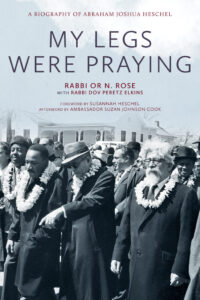
My Legs Were Praying: A Biography of Abraham Joshua Heschel
By Rabbi Or N. Rose Monkfish 2025
Save 20% on Monkfish titles on Indiepubs, with FREE SHIPPING for orders of $40 or more.
You can subscribe to The Monkfish Reader here.
Follow us on social media: